.jpeg)
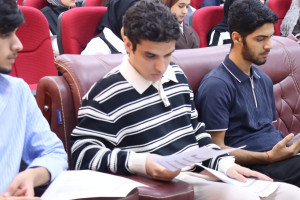
The College of Computer Science and Information Technology at University of Basrah organized a scientific lecture titled "Detecting Deepfakes in Facial Images: An Overview of Methods, Challenges, and Applications."
The lecture aimed to introduce how artificial intelligence can be used to detect manipulation in facial images and distinguish between authentic images and those generated artificially. It highlighted the importance of these technologies in identity verification, the screening of images prior to media publication, the authentication of images circulating on social media platforms, and assisting experts in examining images submitted as evidence in court.
The lecture—presented by master’s student Karrar Haider Abdul-Samad from the Department of Computer Information Systems, under the supervision of Professor Maysaa Abdul-Karim Nasser—covered the most prominent forms of forgery, including the generation of entire faces, face-swapping, and the alteration of facial features or expressions.
The researcher reviewed ten recent studies, explaining how deep learning models identify manipulation by analyzing subtle details, such as inconsistencies in skin texture or the appearance of edges at the points where a face has been integrated. He also discussed the impact of image compression and noise on detection accuracy, as well as the ability of these models to pinpoint manipulated areas and detect forgery techniques for which they had not been specifically trained.

.jpeg)
.jpeg)
Important News
.jpeg)
.jpeg)
viewed most